Code Block Configuration
You can write Map of Content (MOC) queries manually in any markdown file by creating a code block with the language set to moc and adding a YAML configuration.
Syntax Overview
A basic moc code block looks like this:
```moc
folder: Diary
element: List
filter: contains("MOC")
recursive: true
```
Configuration Keys
folder (Required)
The folder path relative to the vault root where the plugin will search for markdown notes.
- Examples:
Diary,Projects/Marketing, or""(empty string to search the entire vault). - Supports dynamic parameters:
{{this.filename}},{{this.folder}},{{this.path}}(see Dynamic Parameters).
element (Required)
The specific markdown element to extract from matching notes. Must be one of the following:
List: Bulleted or numbered list items.Task: Checkbox task items.Heading: Note headers (H1 to H6). The entire section (heading + body until the next same-level heading) is extracted.Paragraph: Markdown paragraph blocks.Blockquote: Markdown blockquotes.
filter (Required)
The matching condition applied to each candidate element. Supports both primitive functions and complex logical expressions.
- Supports dynamic parameters:
{{this.filename}},{{this.folder}},{{this.path}}.
Primitive condition functions:
- String & text matches:
-
contains("term"): Evaluates if the element text contains the specified substring (case-sensitive). (has_wordandhas_textare backward-compatible aliases.)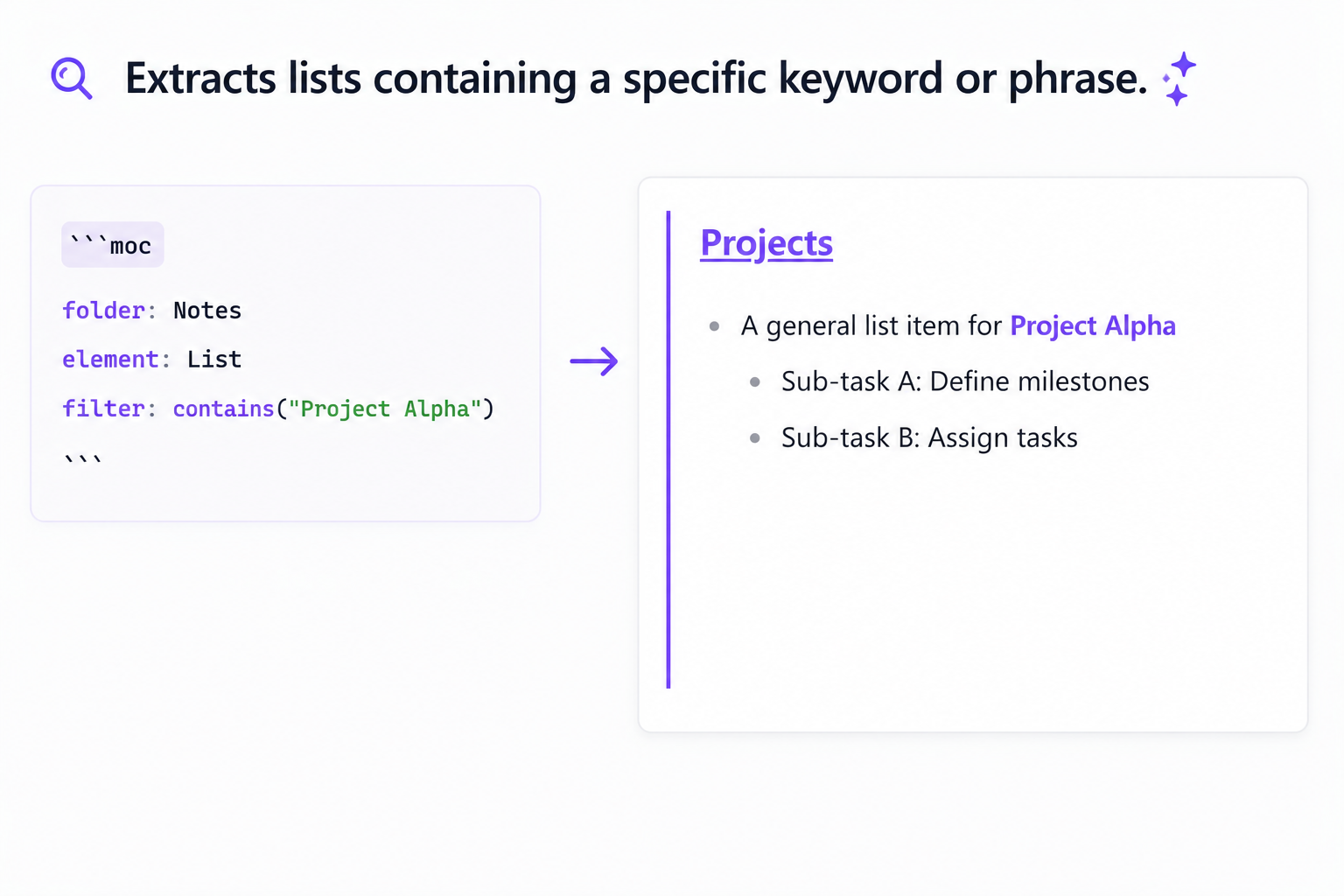
-
- Regular expressions:
matches("regex_pattern"): Evaluates the element using a regular expression match. Supports optional slash-delimited format with flags, e.g.matches("/pattern/i").
- Tags:
has_tag("#tag"): Evaluates if the element contains the specified hashtag (fully tag-aware, case-insensitive, and matches subtags like#tag/subtag).
- Tasks (only when
elementisTaskorList):-
is_completed(): Matches completed tasks. -
is_incomplete(): Matches incomplete tasks.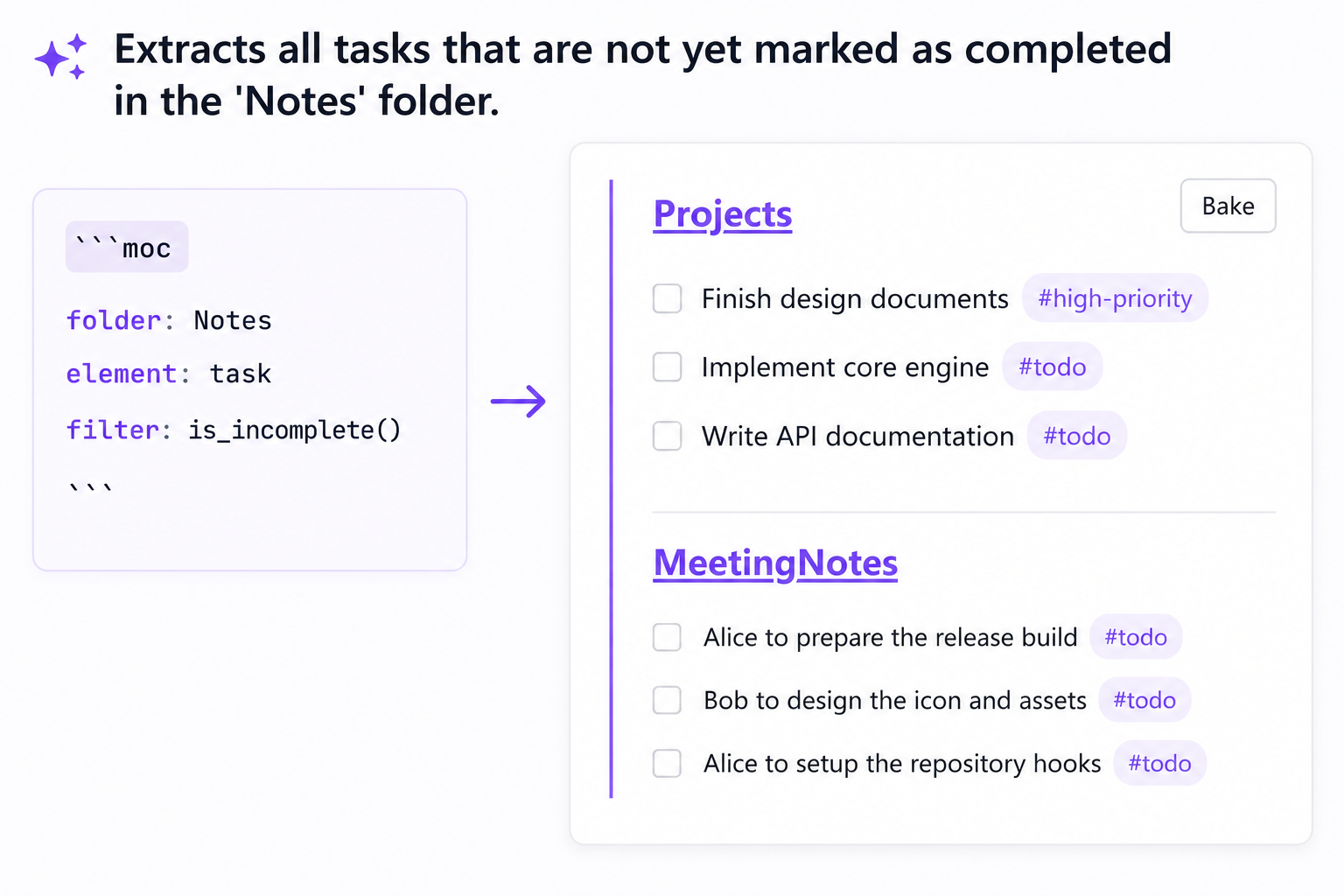
-
- Frontmatter properties:
-
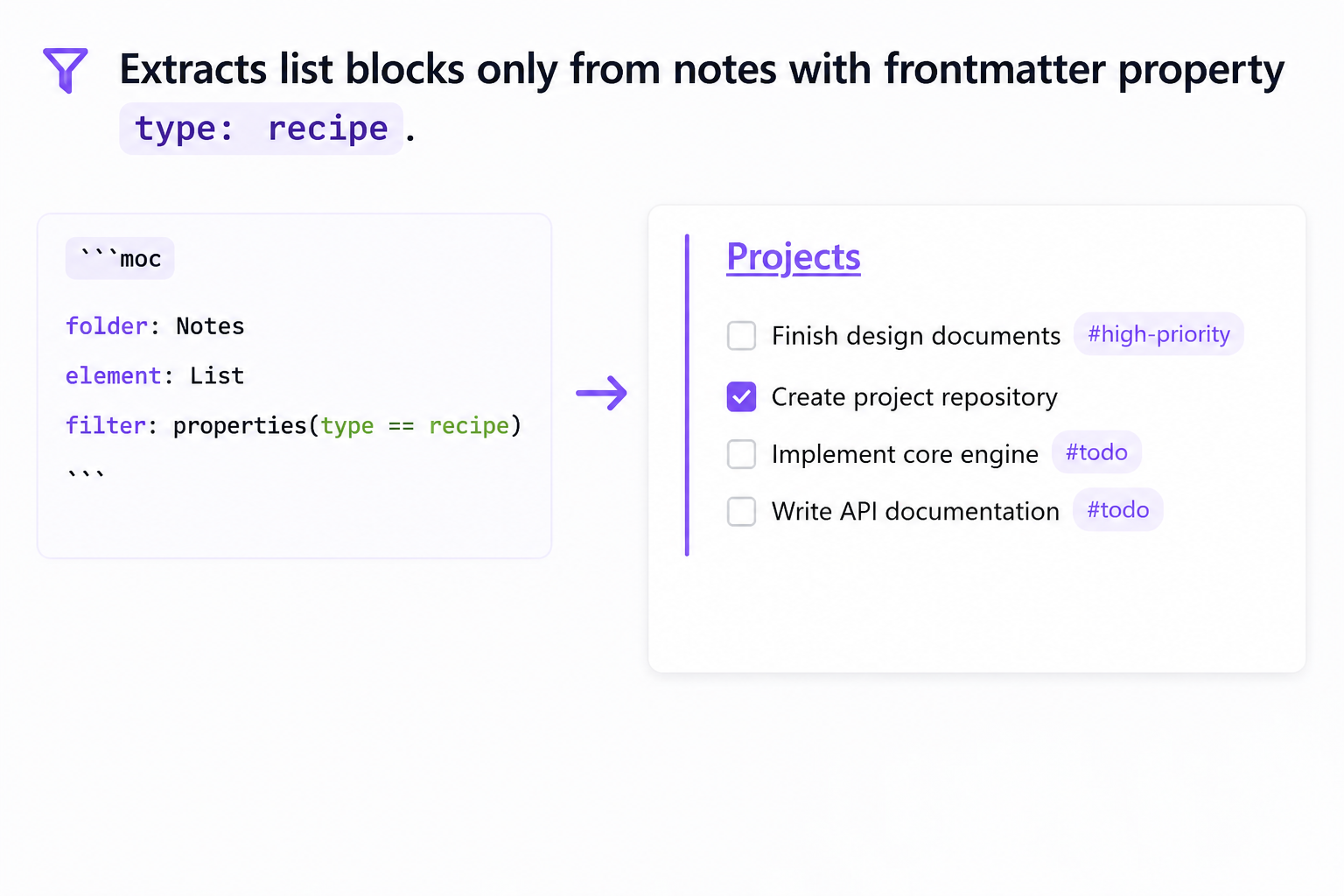
properties(key == value): Matches files where the frontmatter propertykeyequalsvalue. -
Supported operators:
==,!=,>,<,>=,<=. -
Numeric values are compared numerically; ISO date strings (
YYYY-MM-DD) are compared as dates; all other values are compared as strings. -
Examples:
properties(status == "active")properties(priority <= 2)properties(date >= "2024-01-01")
-
Complex logical expressions:
Combine primitive conditions using AND, OR, and NOT. Use parentheses to enforce precedence.
Example: filter: contains("MOC") AND NOT (is_completed() OR has_tag("#todo"))
recursive (Optional)
A boolean determining whether subfolders of the target folder should also be searched.
- Values:
trueorfalse(defaults tofalse).
groupBy (Optional)
Groups the extracted elements under subheadings.
- Values:
folder: Groups elements by their source note's folder.cday: Groups elements by their source note's creation date (YYYY-MM-DD).mday: Groups elements by their source note's modification date (YYYY-MM-DD).tag: Groups elements by the hashtag(s) found inside the element's text (elements with no tags fall under "Untagged").property(key): Groups elements by the value of the specified frontmatter property key. Elements from notes where the property is missing or empty are grouped under(none).- Example:
groupBy: property(status)
sort (Optional)
Sorts the matching source notes before processing and extracting elements.
- Format:
<field> <direction> - Fields:
name(filename),ctime(creation date),mtime(modification date) - Directions:
asc(ascending),desc(descending) - Example:
sort: mtime desc
limit (Optional)
Limits the maximum number of markdown files processed. Must be a positive integer.
- Example:
limit: 10
offset (Optional)
Skips the specified number of files at the start of the (sorted) file list before processing. Must be a non-negative integer. Use together with limit to paginate results.
- Example:
offset: 5(skip the first 5 files, then applylimit)
showCount (Optional)
When set to true, appends a result count summary at the bottom of the MOC block (e.g. 3 results in 2 files). When groupBy is active, each group heading also shows the number of elements in that group.
- Values:
trueorfalse(defaults tofalse). - Example:
showCount: true
excludeFolder (Optional)
Explicitly excludes one or more folders from the search results, even when they fall within the configured folder and recursive: true is set. Paths are relative to the vault root.
- Format: a single string or a JSON array of strings.
- Example (single):
excludeFolder: Projects/Archive - Example (multiple):
excludeFolder: ["Projects/Archive", "Templates"]
excludeFile (Optional)
Explicitly excludes one or more files from the search results. Paths are relative to the vault root and can be specified with or without the .md extension.
- Format: a single string or a JSON array of strings.
- Example (single):
excludeFile: Projects/Template - Example (multiple):
excludeFile: ["Projects/Template", "Daily/2024-01-01"]
template (Optional)
The name of a template note (not inline text) used to define a custom output format for each matched element. The template is applied after any applyFnR transformations.
Templates are resolved against the Template folder configured in Settings → Maps of Content. To use a template:
- Set a Template folder in the plugin settings (e.g.
Templates). - Create a note inside that folder whose content is the format string, using handlebars-style
{{placeholder}}syntax — for example a note namedbullet-link.mdcontaining- {{content}} — [[{{path}}|{{file}}]]. - Reference the note's basename (without
.md) in thetemplatekey:template: bullet-link.
Available placeholders (used inside the template note's content):
| Placeholder | Value |
|---|---|
{{content}} | The matched element text |
{{file}} | Source file basename (without extension) |
{{path}} | Source file path relative to vault root |
{{link}} | Wiki-link to the source file: [[path|basename]] |
- Example:
template: bullet-link(whereTemplates/bullet-link.mdcontains- {{content}} — [[{{path}}|{{file}}]])
applyFnR (Optional)
Applies reusable Find & Replace rules defined in the plugin's settings to the matched block contents. Can be a single rule name string or a JSON array of rule names. If an array is provided, the rules are applied sequentially in the specified order.
- Format:
stringorstring[] - Example (single):
applyFnR: clean-headers - Example (chain):
applyFnR: ["strip-comments", "clean-headers"]
blockSeparator (Optional)
Defines the separator rendered between different matched blocks extracted from the same note.
- Values:
none(default): Blocks are joined directly (useful for joining consecutive lists).divider: A horizontal rule---is inserted between blocks.newline: A blank line is inserted between blocks (useful for separating paragraphs).
- Example:
blockSeparator: newline
noteSeparator (Optional)
Defines the separator rendered between block groups from different notes.
- Values:
newline(default): A single empty line separates note sections.divider: A horizontal rule---is inserted between note sections.none: Note sections are joined directly without extra spacing.
- Example:
noteSeparator: divider
Dynamic Parameters
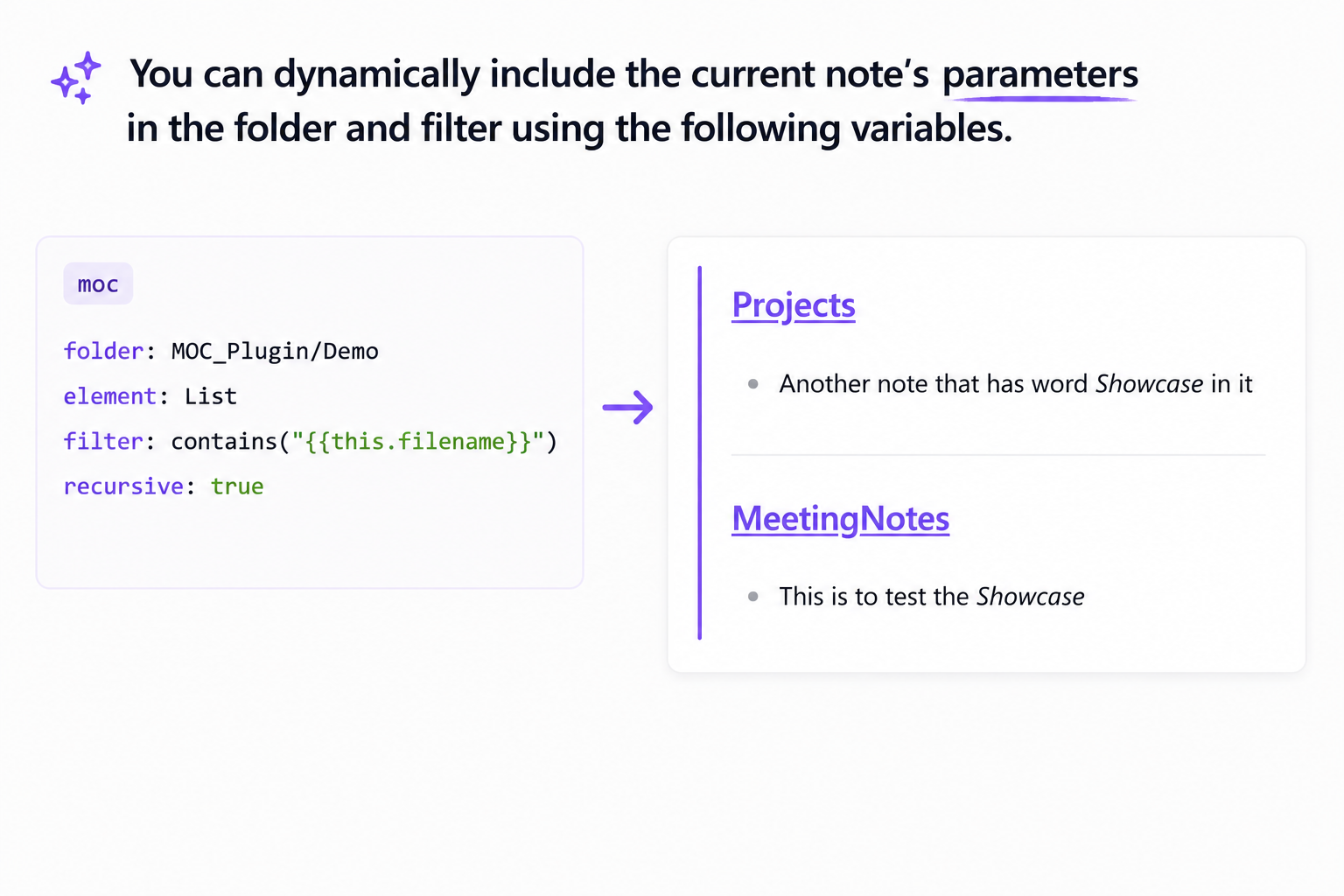
You can dynamically include the current note's parameters in the folder and filter options using the following variables:
{{this.filename}}: Expands to the current note's name (without the.mdextension).{{this.folder}}: Expands to the name of the folder containing the current note.{{this.path}}: Expands to the full path of the current note (without the.mdextension).
For example, to list elements from the Diary folder that contain the current note's name:
```moc
folder: Diary
element: List
filter: contains("{{this.filename}}")
recursive: true
```